Are Big Investors Really Buying Up All the Homes? Here’s the Truth.
If you've been following real estate news lately — or just scrolling social media — you've probably seen some version of this claim: "Hedge funds and corporations are buying up all the homes and pricing out regular buyers."
And honestly? If you've lost out on a few offers recently, that narrative probably feels believable. When competition is stiff and prices are high, it's easy to assume there must be some massive institutional force working against you behind the scenes.
But what people assume is happening and what the data actually shows are two very different things. Let's look at the real numbers.
The Stat That Puts Everything in Perspective
According to John Burns Research & Consulting, large institutional investors — defined as those owning 100 or more homes — made up just 1.2% of all home purchases in Q3 of 2025.
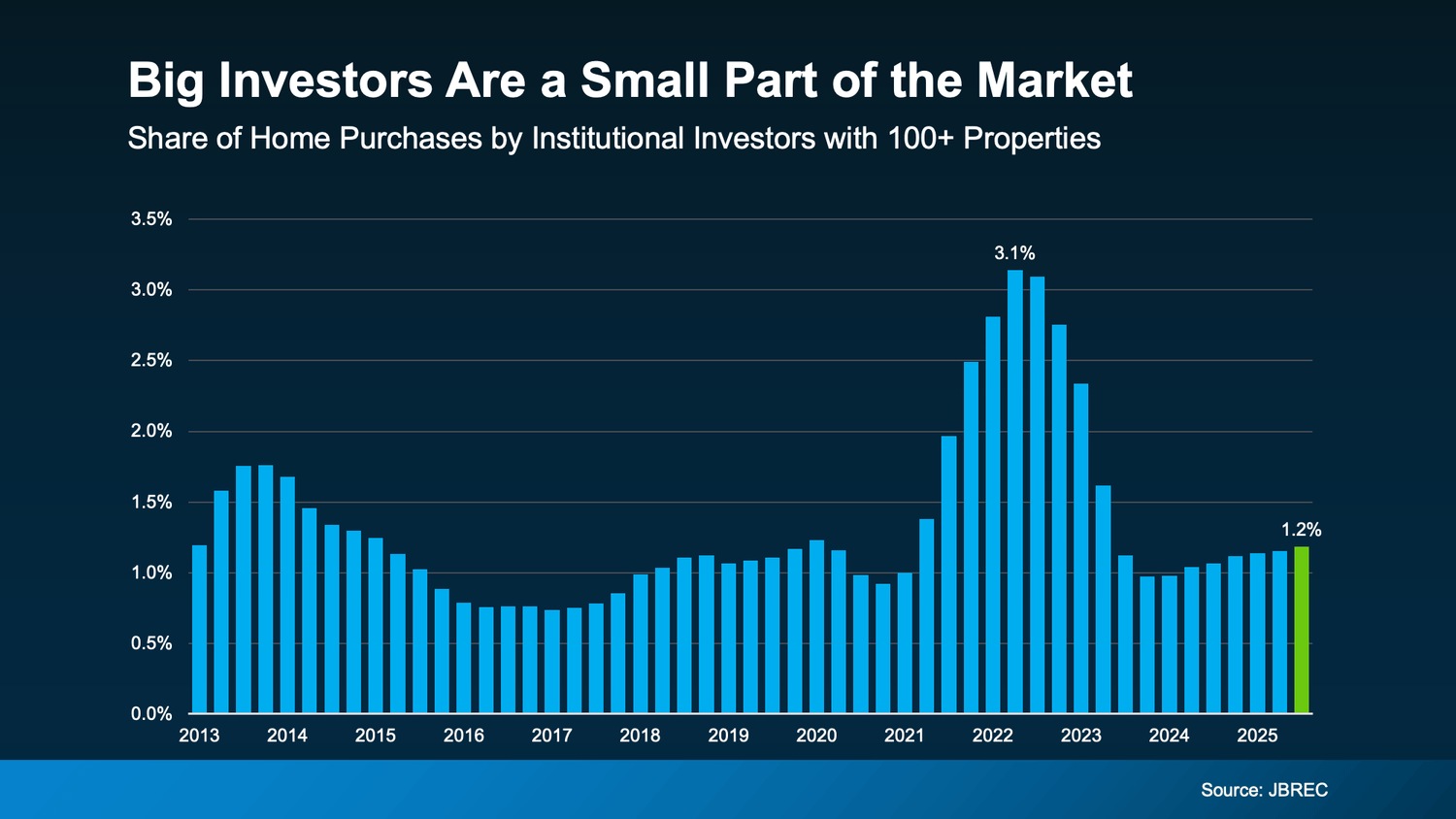
Let that sink in. Out of every 100 homes sold in this country, roughly one went to a large institutional investor.
And that 1.2% figure isn't unusually high — it's actually well below the recent peak of 3.1% back in 2022, which itself was still a tiny slice of the overall market. The trend isn't large investors gobbling up more homes. It's them pulling back.
So Why Does This Story Keep Getting Told?
There are two main reasons this narrative has so much staying power — and both are worth understanding.
Reason 1: Investor activity isn't spread evenly.
Nationally, large investors own around 1% of all single-family homes. But as ResiClub Co-Founder Lance Lambert notes, in a handful of regional markets, institutional and large single-family landlords have a meaningfully larger presence than the national average suggests.
So if you happen to be buying in one of those specific markets, the competition from investors can feel more real — because in that zip code, it is more real. That local experience gets amplified online and shared as if it represents the entire country. It doesn't.
Reason 2: "Investor" is an extremely broad term.
Here's where a lot of the confusion gets manufactured. Most headlines lump together massive Wall Street corporations with your neighbor who owns a couple of rental properties — and call them all "investors."
Those are not the same buyer. A hedge fund purchasing hundreds of homes in a single market operates completely differently from a local landlord who bought one rental as a retirement investment. But when all of those groups get counted together in a single headline stat, the number inflates — and it creates the impression that corporate giants are dominating the market in a way the data simply doesn't support.
What's Actually Making Homeownership Hard Right Now
This matters — because if you misidentify the problem, you can't solve it.
The real affordability challenges in Southern California and most of the country come down to supply, demand, and years of underbuilding. For over a decade following the 2008 crash, builders dramatically pulled back on new construction. That created a housing deficit that's been playing out ever since — and it's the primary driver of why prices have been elevated and inventory has been tight.
Large institutional investors buying 1.2% of homes didn't create that problem. And reducing that number to zero wouldn't meaningfully fix it.
In Rancho Cucamonga and the Inland Empire, the supply constraints and population growth driving buyer competition have very little to do with corporate investors. In Pasadena and LA County, limited land, strict zoning, and high construction costs are far bigger factors in the affordability equation than what any hedge fund is doing.
Understanding that distinction matters — because it helps you focus your energy on what you can actually control, rather than waiting for a problem that isn't the main issue to get resolved.
What This Means for You as a Buyer
Here's the practical takeaway: the competition you're facing in most Southern California markets is coming from other people like you — families, first-time buyers, move-up buyers, people who want a home in a good neighborhood with good schools.
That's actually a more level playing field than the headlines suggest. And it means the way to compete isn't to wait until corporate investors stop buying — it's to show up better prepared than the other everyday buyers you're actually competing against.
Pre-approved. Clear on your budget. Working with an agent who knows the local market. Ready to move when the right home appears.
That's the strategy. And it works.
BOLD LA KEY TAKEAWAY
Large institutional investors make up about 1% of home purchases nationally — and their share is shrinking, not growing. The affordability challenges you're experiencing are real, but they're being driven by supply and demand fundamentals, not corporate landlords scooping up everything in sight.
Don't let a misleading narrative keep you from understanding what's actually happening in your specific market — and what it would actually take to compete in it successfully.
If you want a straight read on what investor activity looks like in your target area and how it actually affects your options as a buyer, let's talk. Context changes everything.


Terrell Bolden
REALTOR®
DRE#02110062
Realty Connection Group
Los Angeles, California
(323) 471-5295
Terrell Bolden has always had a passion for real estate and how it can be used as a tool to enhance daily life.
-A safe place to call home and raise a family.
-An appreciating asset that can be passed to loved ones, or used to finance the vacation of your dreams.
Terrell understands that real estate opportunities are plentiful and is deeply committed to helping others achieve their real estate dreams throughout the greater Los Angeles area.
Disclaimer: The information contained, and the opinions expressed, in this article are not intended to be construed as investment advice. Terrell Bolden, Realty Connection Group, DRE #02110062 does not guarantee or warrant the accuracy or completeness of the information or opinions contained herein. Nothing herein should be construed as investment advice. You should always conduct your own research and due diligence and obtain professional advice before making any investment decision. Terrell Bolden, Realty Connection Group, DRE #02110062 will not be liable for any loss or damage caused by your reliance on the information or opinions contained herein.
Let us know what you think in the comments!
Quick links
Newsletter
Subscribe to the newsletter and stay in the loop! By joining, you acknowledge that you'll receive our newsletter and can opt-out anytime hassle-free.