The Mid-Year Housing Market Reality Check: What Changed, What Didn't, and What It Means for You.
At the end of 2025, the housing market forecast for 2026 looked pretty optimistic. Rates were expected to come down. Affordability was supposed to improve meaningfully. Home sales were projected to rebound.
Then reality had a different plan.
If the market feels more confusing than expected right now — you're not imagining it. And you deserve a straight explanation of what actually happened and what it means for the rest of the year.
What the Experts Got Wrong — And Why
The forecasts that were built at the end of 2025 assumed a few things would fall into place: inflation would continue cooling, geopolitical tensions would ease, and mortgage rates would follow both of those things downward.
None of that happened the way anyone expected.
Lingering inflation, ongoing global uncertainty, and escalating geopolitical tensions overseas kept upward pressure on bond yields — and mortgage rates responded. Instead of settling into the low 6s as originally projected, rates stayed elevated longer than virtually anyone anticipated.
And when rates stay elevated, buyers hesitate. When buyers hesitate, sales slow. When sales slow, the entire market adjusts.
That's exactly what happened. And it's why economists recently revised their forecasts for the second half of 2026:
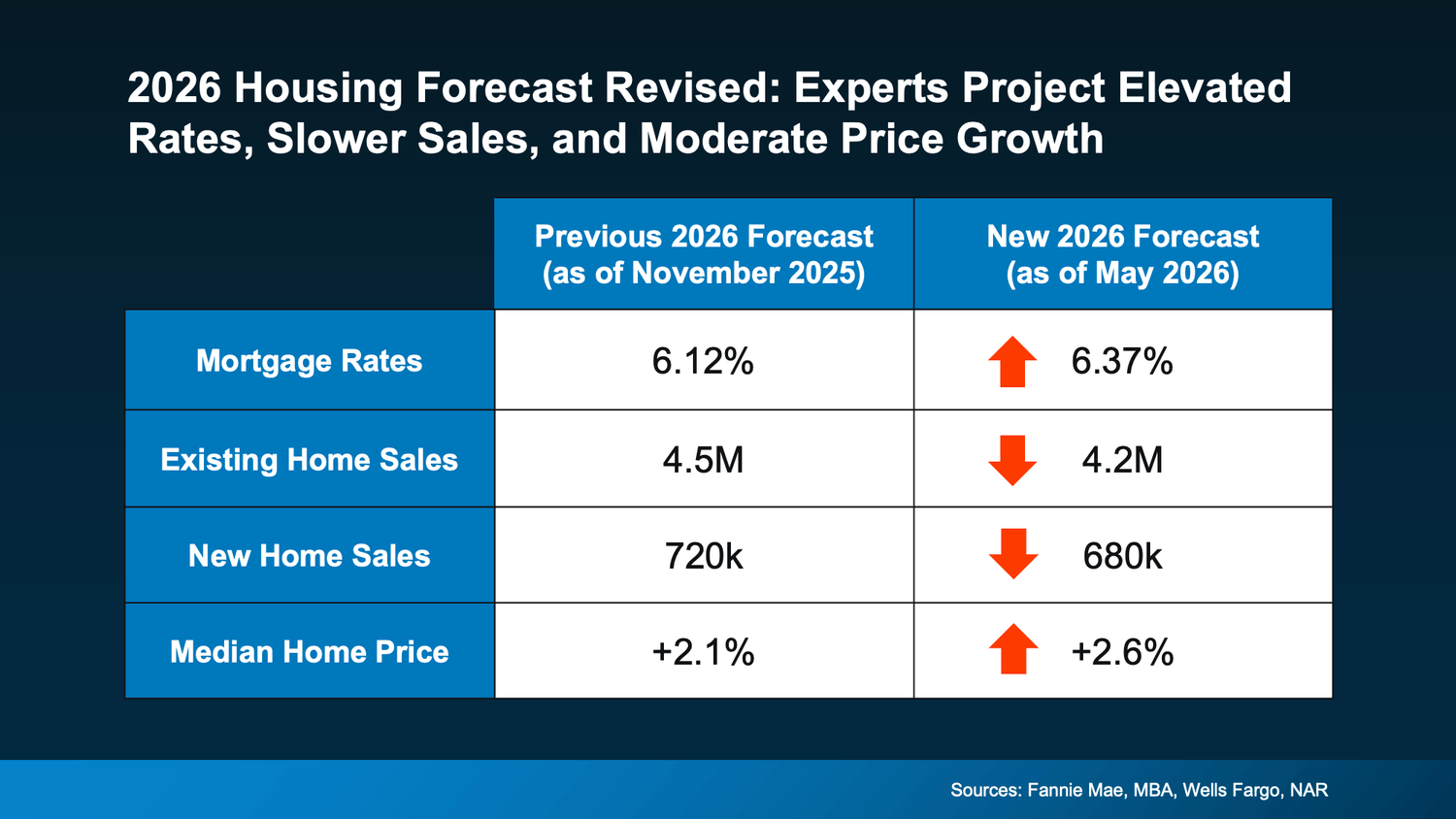
Let's break down exactly what changed — and what it actually means for you.
Mortgage Rates: Lower Than Last Year, Higher Than Expected
The honest update on rates is this: most industry forecasters have revised their projections from the low 6s they originally expected to roughly the mid 6s for the remainder of 2026.
That's not the news buyers were hoping for. But here's the context worth holding onto — rates today are still lower than they were a year ago. The improvement happened. It just didn't go as far as the forecasts suggested it would.
Will rates drop further? Possibly. If geopolitical tensions ease and inflation continues to cool, rates could respond. But banking on that happening on a specific timeline — and putting your life on hold in the meantime — is a gamble that doesn't usually pay off the way buyers expect.
The mid 6s aren't the 3s of 2021. But they're also not the 7.5s of 2023. And for buyers who've been waiting for conditions to improve — conditions have improved. Just not as dramatically as the optimists projected.
Home Sales: Slower Than Expected — But Still Growing
At the end of 2025, forecasters projected roughly 4.5 million existing home sales for 2026. That number has since been revised down to approximately 4.2 million.
That revision tells a clear story: elevated rates kept more buyers on the sidelines than expected. Affordability remained a real challenge — especially for first-time buyers — and that slowed the pace of transactions.
But here's the part that deserves equal attention: 4.2 million home sales is still more than last year. The market didn't stall. It grew — just more slowly than anticipated.
And there's something else worth paying attention to. In recent months, pending home sales have been improving month over month — even with rates elevated. That's a signal of real, underlying demand working its way back into the market.
As NAR Chief Economist Lawrence Yun puts it, there is sizable pent-up demand that could be released into the market once conditions improve. Those buyers haven't gone away. They're waiting. And when rates ease — even modestly — that wave enters the market simultaneously.
For buyers who are able to move now? That's actually a reason to consider acting before that wave arrives. More competition and potentially fewer homes are what greet the buyers who waited.
New Construction: Builder Motivation Is Your Opportunity
New home sales were projected to top 700,000 in 2026. That number has been revised to just shy of that threshold — a modest miss, but a miss nonetheless.
For buyers, though, this revision carries a silver lining that's worth understanding directly.
When builders fall short of their sales targets, they get motivated. And motivated builders negotiate. Rate buydowns. Upgrade packages. Closing cost assistance. Pricing flexibility. These incentives don't appear when builders are selling everything immediately — they appear when builders need to move inventory.
In Rancho Cucamonga and the Inland Empire, where new construction has been one of the most active segments of the market, this dynamic is playing out right now. Buyers who are willing to look at new builds are finding negotiating leverage that didn't exist during the pandemic frenzy — and in some cases, securing better overall terms than they'd find on comparable existing homes.
If you live in or are open to an area with meaningful new construction, this revised forecast is actually good news for your negotiating position.
Home Prices: Here's the Most Important Part of the Forecast
This is the piece of the mid-year update that matters most — and it's the one getting the least attention.
Despite revising their sales volume and rate forecasts downward, economists did not revise their home price forecasts downward. Nationally, prices are still expected to rise this year.
The reason comes back to fundamentals. Buyer demand has softened — but the supply of homes for sale remains relatively limited. That imbalance is doing what it always does: keeping upward pressure on prices even when the market is moving more slowly.
In Pasadena and LA County, that dynamic is particularly pronounced. Structural constraints — limited land, strict zoning, consistent demand from professionals and families — mean prices in desirable areas aren't collapsing just because the broader market has slowed. They're holding. In some neighborhoods, they're still moving up.
In Rancho Cucamonga and the Inland Empire, the same fundamental undersupply that's driven appreciation over the past decade hasn't reversed. More inventory than 2022 doesn't mean abundant inventory — it means buyers have more choices than they did at the peak, while prices continue to be supported by demand that exceeds supply.
For sellers: stable prices mean your equity is protected even in a slower market. For buyers: stable prices mean waiting for a dramatic correction that never comes while values quietly continue their long-term upward trend.
The Bigger Picture — What This Revision Actually Tells You
Here's how I want you to read these revised forecasts:
This isn't a sign that the market is broken. It's a sign that the market is human — responsive to the same global forces and economic uncertainties that affect every other part of your financial life.
The original 2026 forecasts assumed a smoother path than the world provided. Geopolitical tension, sticky inflation, and elevated rates forced an adjustment. But the underlying fundamentals — undersupply, demographic demand, long-term price appreciation — haven't changed.
When uncertainty eases, the pent-up demand that's been building on the sidelines will re-enter the market. And the buyers who positioned themselves before that happens — who did the work, got pre-approved, and made their move while others were still waiting — are the ones who will look back on this period as the right time to have acted.
Bold LA Key Takeaway
The 2026 housing market hasn't rebounded as fast as everyone hoped. Rates are higher than projected. Sales volumes are lower than expected. But prices are still rising, pent-up demand is real and growing, and the buyers who move before that demand fully re-enters the market are the ones who benefit most.
Don't read these revised forecasts as a reason to keep waiting. Read them as a reason to understand exactly where you stand — and what the right move looks like for your specific situation right now.
If you want a straight read on what's happening in your local market and what it means for your plans for the rest of 2026 — let's talk.
That wraps up today's blog — appreciate you stopping by. And as always, if you want it to sell, call Terrell… and if you want to buy, I'm still the guy.

Terrell Bolden
REALTOR®
DRE#02110062
Realty Connection Group
Los Angeles, California
(323) 471-5295
Terrell Bolden has always had a passion for real estate and how it can be used as a tool to enhance daily life.
-A safe place to call home and raise a family.
-An appreciating asset that can be passed to loved ones, or used to finance the vacation of your dreams.
Terrell understands that real estate opportunities are plentiful and is deeply committed to helping others achieve their real estate dreams throughout the greater Los Angeles area.
Disclaimer: The information contained, and the opinions expressed, in this article are not intended to be construed as investment advice. Terrell Bolden, Realty Connection Group, DRE #02110062 does not guarantee or warrant the accuracy or completeness of the information or opinions contained herein. Nothing herein should be construed as investment advice. You should always conduct your own research and due diligence and obtain professional advice before making any investment decision. Terrell Bolden, Realty Connection Group, DRE #02110062 will not be liable for any loss or damage caused by your reliance on the information or opinions contained herein.
Let us know what you think in the comments!
Quick links
Newsletter
Subscribe to the newsletter and stay in the loop! By joining, you acknowledge that you'll receive our newsletter and can opt-out anytime hassle-free.