Foreclosures Are Up 32%. Here's Why That Headline Is Missing the Most Important Part.
If you've been seeing headlines about foreclosure activity climbing for ten straight months, it's completely understandable to feel uneasy. The word "foreclosure" carries a lot of weight — especially for anyone who lived through 2008 and watched what that crisis did to families, neighborhoods, and home values.
But here's what those headlines aren't telling you: context changes everything. And when you look at the full picture, this story is very different from what the alarming framing suggests.
Yes, Foreclosures Are Up. Here's What That Actually Means.
ATTOM data shows foreclosure filings are up 32% year-over-year. That sounds dramatic. And if you read it without context, it's supposed to.
But let's put that number next to what actually happened during the 2008 crisis:
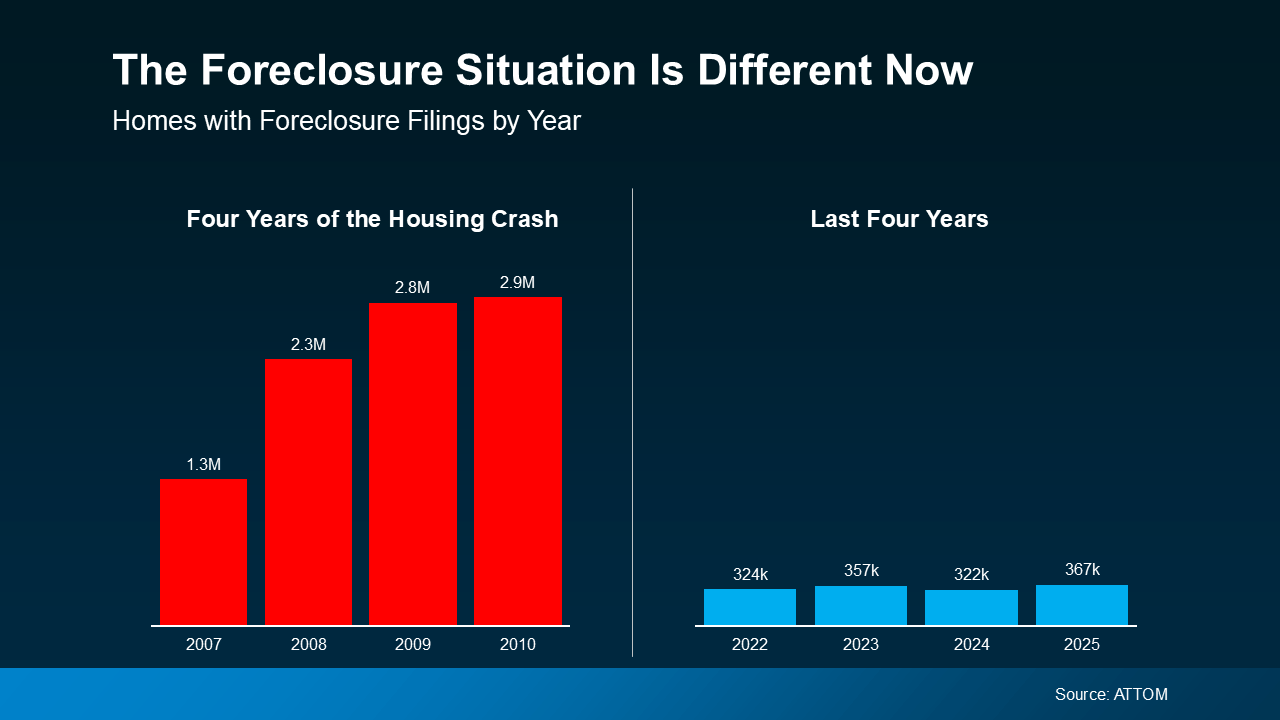
We are nowhere near those levels. Not even close.
During the years following the 2008 crash, foreclosure filings regularly exceeded one million per year. What we're seeing now — even with the recent uptick — is a fraction of that. And when you zoom out even further:
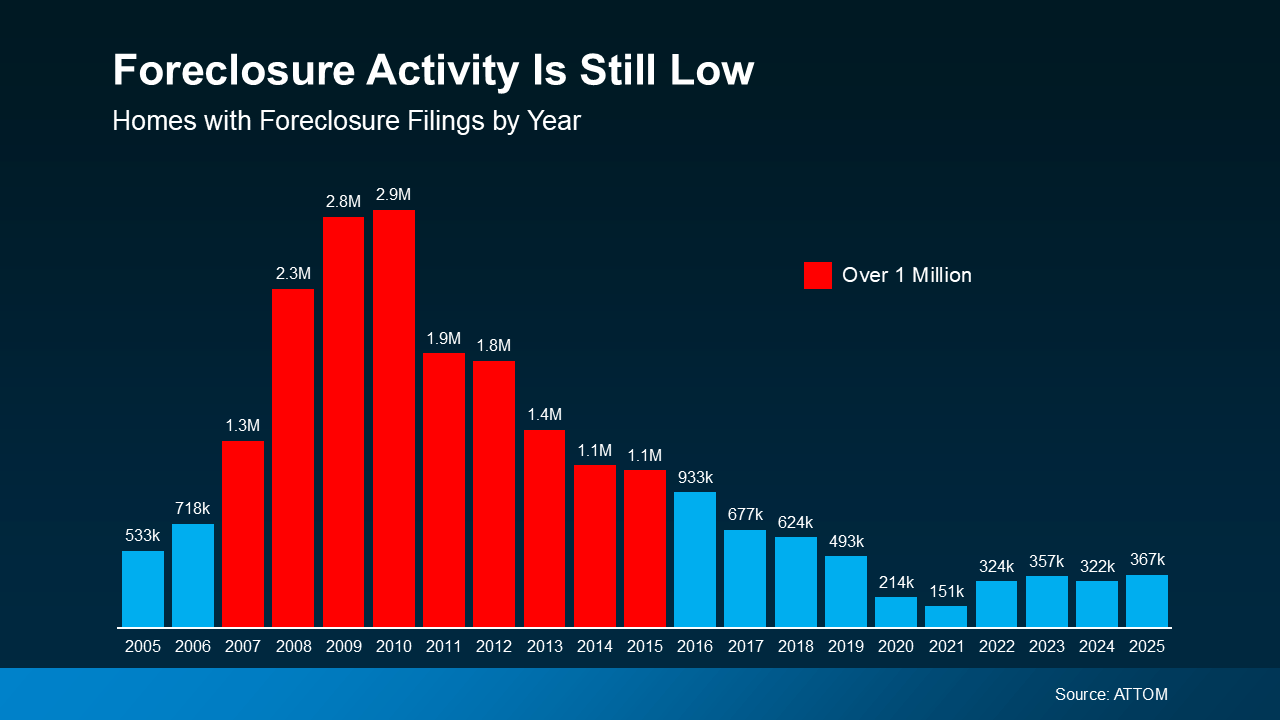
When you look at the 2017–2019 range — the last years the housing market was operating normally before the pandemic distorted everything — today's numbers are simply returning to that baseline. That's not a warning sign. That's the market recalibrating.
As ATTOM CEO Rob Barber explains, foreclosure activity in 2025 reflects continued normalization following several years of historically low levels. While filings rose compared to 2024, they remain well below pre-pandemic norms and a fraction of what occurred during the last housing crisis. Today's uptick is being driven more by market recalibration than widespread homeowner distress.
The word he used — normalization — is the most important one in that quote. This isn't a flood of distressed homes entering the market. It's the data returning to where it was before pandemic-era mortgage forbearance programs artificially suppressed it.
Why This Isn't 2008 — And the Difference Is Significant
The reason 2008 was so devastating came down to two things that don't exist in today's market:
Reckless lending. Back then, loans were being handed out to borrowers who couldn't realistically afford them — adjustable-rate mortgages with artificially low starter rates, no documentation requirements, zero-down loans on overvalued properties. When those conditions collided, the system collapsed.
Underwater homeowners. When prices crashed, millions of homeowners suddenly owed more than their homes were worth. They had no equity cushion. No financial options. Foreclosure wasn't just possible — it was inevitable for many of them.
Neither of those conditions exists today. Lending standards are significantly stricter. Borrowers are more qualified. And most importantly — homeowners have substantial equity.
Over the last five years, home values across Southern California and most of the country appreciated significantly. That appreciation created a financial cushion that fundamentally changes what happens when a homeowner faces hardship today.
If someone in Pasadena or Rancho Cucamonga runs into financial difficulty right now, they typically have options that 2008 homeowners didn't. They can sell. They can walk away with money in their pocket. They can use their equity to navigate a tough stretch without losing their home.
That equity buffer is the single biggest reason this situation is not a repeat of the last crisis — and it's the detail that most foreclosure headlines completely ignore.
What This Means for the Housing Market
Here's the practical implication for buyers and sellers in Southern California:
A wave of distressed properties flooding the market and crashing prices? The data doesn't support that scenario. The homeowners who are facing foreclosure today represent a small fraction of the overall market — and most of them have equity that gives them alternatives to foreclosure.
For buyers hoping that a surge of cheap distressed homes is coming — it's probably not. For sellers worried that foreclosures will drag down their home's value — the fundamentals don't point in that direction.
What we're seeing is a market normalizing. Not crashing. Not collapsing. Normalizing. And there's a big difference.
The Bigger Issue: Why These Headlines Keep Getting It Wrong
Here's something worth understanding about the way real estate news gets made: fear drives clicks. A headline that says "foreclosure activity returns to normal levels" doesn't get shared. A headline that says "foreclosures surge for 10th straight month" generates anxiety — and anxiety generates engagement.
That dynamic means the framing of these stories is often designed to alarm, not inform. And for buyers and sellers trying to make real decisions about real money, that's genuinely harmful.
The antidote isn't ignoring the news. It's having someone in your corner who can tell you what the numbers actually mean — for the national market, for Southern California specifically, and for your individual situation.
BOLD LA KEY TAKEAWAY
Foreclosure activity is rising — but it's rising back toward normal, not toward crisis. The underlying conditions that caused 2008 — reckless lending, underwater homeowners, oversupply — simply don't exist in today's market. Strong equity positions and stricter lending standards are doing exactly what they're supposed to do: limiting risk.
When you see a headline about housing that worries you, don't let it sit and fester. Reach out. I'll tell you straight what it means, what it doesn't mean, and whether it has any real impact on your situation.
That's exactly the kind of clarity you deserve when you're making one of the biggest financial decisions of your life.

Terrell Bolden
REALTOR®
DRE#02110062
Realty Connection Group
Los Angeles, California
(323) 471-5295
Terrell Bolden has always had a passion for real estate and how it can be used as a tool to enhance daily life.
-A safe place to call home and raise a family.
-An appreciating asset that can be passed to loved ones, or used to finance the vacation of your dreams.
Terrell understands that real estate opportunities are plentiful and is deeply committed to helping others achieve their real estate dreams throughout the greater Los Angeles area.
Disclaimer: The information contained, and the opinions expressed, in this article are not intended to be construed as investment advice. Terrell Bolden, Realty Connection Group, DRE #02110062 does not guarantee or warrant the accuracy or completeness of the information or opinions contained herein. Nothing herein should be construed as investment advice. You should always conduct your own research and due diligence and obtain professional advice before making any investment decision. Terrell Bolden, Realty Connection Group, DRE #02110062 will not be liable for any loss or damage caused by your reliance on the information or opinions contained herein.
Let us know what you think in the comments!
Quick links
Newsletter
Subscribe to the newsletter and stay in the loop! By joining, you acknowledge that you'll receive our newsletter and can opt-out anytime hassle-free.